I'm currently at the Deutsches Literatur Archiv in Marbach where I am researching the mostly forgotten post-war German writer Werner Riegel (more info from
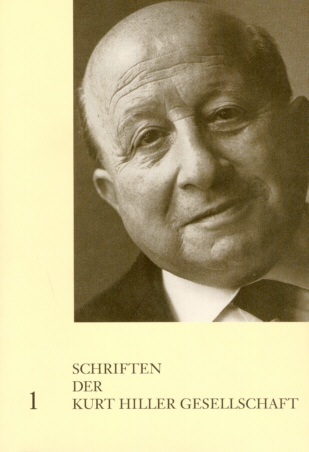
Wikipedia for the curious). As so often during research, what we find is not always what we initially look for, and I've had the pleasure of acquainting myself more with the work of Kurt Hiller, the essayist and publisher who was one of the first figures of the older generation to offer his support and guidance to Riegel and his colleague Peter Rühmkorf during the early stages of their careers.
Hiller is known primarily as a pacifist, a non-orthodox socialist in the tradition of Aktivismus and an early proponent of gay rights. His essays are hilarious, firebrand broadsides, maybe lacking the
Verfeinung of Kraus' criticism, yet possessing a certain aggression which is undoubtedly what so attracted Riegel and Rühmkorf. Hiller's witticisms are anything but frivolous.
Yet the one aspect of Hiller's criticism that I find most fascinating is his anti-Hegelianism. Hiller always presented himself as part of a somehow Schopenhauerian Marxist tradition, a move which, in criticizing the Hegelianism of other Marxist movements, would bring him into conflict with certain communist groups. For Hiller the
Aktivist, Hegel represents the passive observation of the historical process, and the intellectualizing reformation of history into a theory which only justifies, and cannot criticize. Hiller is close in spirit to Kierkegaard in such denunciations of Hegelian mystification.
Übrigens ist unter den Gattungen philosophischer Hochstapelei jene, die sich bemüht, die Vernunft verächtlich zu machen, nur die zweitärgste. Die ärgste ist die, deren fauler Tiefsinn uns weismachen möchte, die Vernunft herrsche bereits, sie sei das der Welt immanente Prinzip, sie komme in jedwedem vorgefundenen Staat nicht minder zum Ausdruck als in den Bahnen der Gestirne, und unsre einzige Aufgabe sei, ihrer gewahr zu werden, gerade in den zufälligen und überlebten Organisaten fragwürdiger menschlicher Macht. Den vorgefundenen Staat nicht kritisieren, ihn nicht ändern und umformen wollen, nein, ihn als Ausdruck der Weltvernunft begreifen lernen, um sich mit ihm zu "versöhnen", mag er beschaffen sein wie -auch-immer, - das lehrte Hegel und das impliziert auch die mit einem fashionablen Ismus beklebte moderne Hegelei. Wir dürfen Hegel definieren: Hegel oder die Deutung des Massenmords an Kindern als Ausdruck der Weltvernunft.
Hiller would also criticize this philosophical distancing from political reality (which has a rich history in German literature, stemming most prominently from Goethe's aloof attitude towards the political events of the 1790s) in Thomas Mann. Yet the question is not simply political for Hiller. It is concerned more generally with ethics, and the conservative collusion between philosophy (in the Hegelian tradition) and power.
'Das, was ist, zu begreifen, ist die Aufgabe der Philosophie, denn das, was ist, ist die Vernunft.' Dieser Ausspruch, Damen und Herren, stammt aus keinem Parodien-Atelier; dieser Ausspruch ist von Hegel. Es ist der Schwertstich durch alle Ethik, es ist der konservativste, der schmierigste Satz der Weltlitteratur.
 |
| Stuttgart 2 days ago. (Hegel: exactly wrong) |
Mann speaks annoyingly and condescendingly of his respect for Hiller before claiming that "Hillers Feindschaft gegen mich ist die der Aufklärung gegen die Romantik," as if Hiller wasn't an Aktivist/socialist and Mann himself didn't stand for the worst bourgeois, un-political non-engagement.
More gems from Hiller can be found here:
http://www.hiller-gesellschaft.de/prosa.htm